How AI Document Translation Works (and Where It Still Struggles)
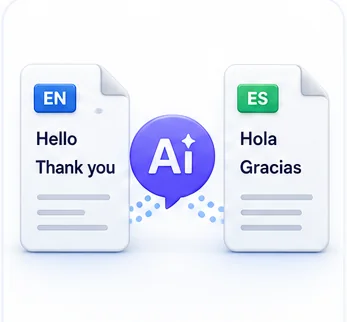
Older machine translation worked mostly phrase by phrase, swapping chunks of one language for the statistically most likely chunk in another — which is why it so often produced sentences that were technically translated but read stiffly, like they'd been assembled from a phrasebook rather than genuinely written. Modern AI translation works differently, and understanding that difference is the key to knowing when to trust it and when to check it carefully.
Translating meaning, not just words
Large language models translate by understanding the meaning and intent of a full passage — not just looking up each word or short phrase in isolation. That's why AI translation handles idioms, tone, and context-dependent word choice noticeably better than older systems: it can recognize that a phrase is figurative rather than literal, or that a formal document calls for formal register in the target language, and adjust accordingly.
This matters most for anything where tone carries real meaning — a cover letter, a customer-facing email, marketing copy — where a technically-correct-but-awkward translation can undermine the whole point of the document even if every individual word is accurate.
Preserving document structure during translation
Translating text is only half the job for a real document — the other half is keeping headings as headings, lists as lists, and tables as tables in the output, rather than collapsing everything into one undifferentiated block of translated text. This requires the translation process to work with the document's actual structure (extracting headings, paragraphs, and list items as distinct, ordered pieces) and reassemble them in the same structure afterward, not just translate a flat wall of text and hope formatting survives.
Where AI translation still genuinely struggles
- Highly technical or legal terminology, where a single wrong word can change the actual meaning of a clause — always have a qualified human review anything legally binding, no matter how fluent the translation reads.
- Extremely dense tables and multi-column layouts, where the underlying document structure itself is ambiguous even before translation enters the picture — the same challenge PDF-to-Word conversion faces.
- Culturally-specific references, wordplay, and humor, which often have no direct equivalent in another language and require a genuinely creative (not literal) rewrite that AI can approximate but not guarantee.
- Extremely long documents translated as small, disconnected batches can occasionally lose consistency in how a specific term is translated from one section to another.
Why translation tools offer different speed/accuracy modes
A faster translation mode typically uses a lighter-weight pass optimized for speed and cost — good for quickly understanding the gist of a foreign-language document. A more accurate mode spends more effort per sentence, checking context more carefully and producing more natural, precise phrasing — better suited for anything you're going to send to someone else or rely on for a decision. Choosing the right mode for the stakes involved is more useful than assuming one mode is simply "better" in every situation.
Getting the most reliable translation results
- For anything you're sending externally or relying on for a decision, use the higher-accuracy mode rather than the fastest option.
- For legal, medical, or contractual documents, treat AI translation as a strong first draft for a qualified human translator to review — not a final, submittable document on its own.
- Check tables and numbers specifically after translation. Numbers themselves shouldn't change, but it's worth confirming they landed in the correct cell, especially in dense financial tables.
- If a document uses consistent specialized terminology (a product name, a legal term), check that it was translated the same way throughout — inconsistency is more likely across a long document than within a single paragraph.
Common Mistakes
Sending an AI-translated legal or medical document without human review
A single mistranslated clause can materially change the meaning of a contract or medical instruction. AI translation is a strong starting point for these documents, never a substitute for a qualified human reviewer.
Assuming formatting will automatically survive translation
Not every translation approach preserves document structure. If keeping headings, tables and layout intact matters, confirm your tool is actually built to preserve structure, not just translate a flat block of extracted text.
Using the fastest translation mode for something important
Speed-optimized modes trade some nuance and accuracy for lower cost and faster turnaround. For anything you're sending externally or relying on for a decision, the more accurate mode is worth the extra time.
Translate Your Document Now
Upload a PDF, Word, PowerPoint or text file — or paste text — and get an accurate, side-by-side translation with layout preserved.
Frequently Asked Questions
Related Articles
AI Guides
Can AI Actually Improve Your Resume? What It Can and Can't Fix
AI is genuinely good at tightening weak wording and matching your resume to a job description — but it cannot invent experience you do not have. Here is exactly where the line is.
AI Guides
What Is OCR and When Do You Actually Need It
OCR turns a picture of text into real, searchable, copyable text. Here is what it actually does, how accurate modern AI-powered OCR really is, and the situations where you genuinely need it.
PDF Guides
How to Convert PDF to Word Without Breaking the Formatting
Why PDF-to-Word conversion sometimes scrambles columns and tables, what actually happens under the hood, and how to get an editable document that still looks right.