
How Loan Amortization Actually Works
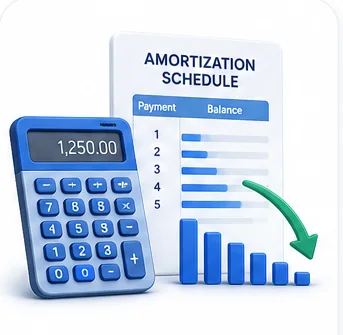
If you've ever looked at your first year of loan payments and felt like the balance barely moved despite paying on time every month, you weren't imagining it. That's not a mistake or a bad deal — it's exactly how amortization is mathematically designed to work, and understanding why changes how you think about extra payments and refinancing.
What "amortization" actually means
Amortization is simply the process of paying off a loan through regular, fixed payments over time, where each payment covers both interest and a portion of the original amount borrowed (the principal). The word describes the schedule, not a special type of loan — almost every standard mortgage, car loan, and personal loan is amortized this way.
Why your early payments are mostly interest, not principal
This is the part that surprises people. Interest is calculated on the current remaining balance, not the original loan amount. Early in a loan, your remaining balance is at its highest (you've barely paid any of it off yet), so the interest portion of each payment is at its highest too — leaving a relatively small amount left over to actually reduce the principal.
As the balance gradually shrinks with each payment, the interest portion shrinks too, which means a growing share of your fixed monthly payment goes toward principal instead. This is why a loan's principal balance often barely moves in year one but drops much faster in the final years — the math compounds in the borrower's favor over time, even though the total payment amount never changes.
Why extra payments are unusually powerful
Because interest is calculated on the remaining balance, any extra payment that goes directly toward principal reduces that balance immediately — which reduces every future interest calculation for the rest of the loan, not just the current month. This compounding effect is why even a relatively small extra payment made early in a loan can save a disproportionately large amount of total interest over the life of the loan, and can shorten the loan term by more than the extra payment amount alone would suggest.
- Extra payments made earlier in the loan save more total interest than the same extra payment made later, because they reduce the balance while there are still more months of interest left to calculate.
- Always confirm with your lender that extra payments are applied directly to principal, not held as an advance on future regular payments — some loans require you to specify this explicitly.
- Even irregular extra payments (not a consistent extra amount every month) still provide real benefit whenever they happen, since the balance reduction compounds from that point forward.
How to actually read an amortization schedule
A full amortization schedule lists every single payment across the life of the loan, broken into three columns: how much of that payment is interest, how much is principal, and what the remaining balance is afterward. Reading a few rows from early, middle, and late in the schedule side by side makes the shifting interest-to-principal ratio immediately visible — the interest column shrinks steadily while the principal column grows, even though the total payment column stays exactly the same throughout.
- Check the total interest paid over the full life of the loan, not just the monthly payment — this is often a genuinely eye-opening number, especially on longer-term loans.
- Look at how the balance changes if you model an extra payment — a good amortization calculator lets you compare the standard schedule against one with extra payments side by side.
- If comparing two loan offers with similar monthly payments but different terms, compare total interest paid over the full loan term, not just the monthly figure, since a longer term can mean paying significantly more in total interest even at a similar monthly payment.
Common Mistakes
Assuming a lower monthly payment always means a cheaper loan
A lower payment often just means a longer term, which can mean paying significantly more total interest over the life of the loan even though each individual payment is smaller. Always compare total interest paid, not just the monthly figure.
Making extra payments without confirming they go toward principal
Some lenders apply extra payments as an advance toward your next regular payment rather than directly reducing principal, which provides far less benefit. Always confirm how extra payments are applied.
Expecting the loan balance to drop evenly across the loan term
The principal balance drops slowly at first and increasingly quickly later, because of how amortization allocates interest against the remaining balance — this is normal, not a sign of a problem with the loan.
Calculate Your Loan Now
Work out monthly repayments, total interest, and total repayment on any loan.
Frequently Asked Questions
Related Articles
Calculator Guides
VAT Explained: A Practical Guide for Small Businesses
What VAT actually is, who really pays it, and how to add or extract it from a price correctly without the common rounding mistakes.

Calculator Guides
Profit Margin vs Markup: They're Not the Same Thing
Confusing these two numbers is one of the most common small-business pricing mistakes, and it can genuinely lead to underpricing. Here is the real difference.

Productivity Guides
How to Organize and Name Your Documents Like a Pro
Most document chaos comes from inconsistent naming and folder structure, not too many files. A few simple conventions fix almost all of it.