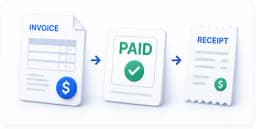
Invoice vs Quotation vs Delivery Note: What's Actually the Difference
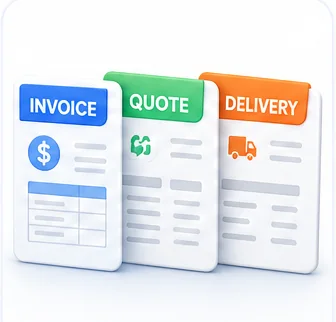
If you run a business — even a very small one — you'll eventually need all three of these documents, and using the wrong one at the wrong moment causes real problems: a quotation sent as an invoice can confuse a customer into thinking they've already been billed; an invoice sent before goods actually ship can create a paper trail that doesn't match reality. The good news is the distinction is simple once you see it laid out.
The quotation: a proposal, not a bill
A quotation (or quote) is an offer — a statement of what you would charge for specific goods or services, sent before any work begins or any goods change hands. It is not a request for payment and creates no obligation for the customer to pay anything. Its entire purpose is to let a potential customer compare your pricing and decide whether to proceed.
A good quotation includes an expiry date (prices can change, and you shouldn't be bound to a quote from six months ago), a clear scope of what's included, and enough detail that if the customer says yes, converting it into an invoice later is straightforward.
The invoice: a formal request for payment
An invoice is a formal, legally significant request for payment for goods or services that have already been provided, or are being provided under an agreed arrangement. Unlike a quotation, an invoice does create an obligation — it's a record that a debt exists and is due, and it's the document accountants and tax authorities actually care about.
- A unique invoice number, for both your own records and the customer's — this matters enormously for accounting and dispute resolution.
- The exact date of issue and the payment due date, since these determine when a payment is officially late.
- A clear itemized breakdown of what's being charged for, including any applicable tax, so the total is fully transparent.
- Your business's registration or tax details where required by local regulation.
The delivery note: proof of what physically arrived
A delivery note (sometimes called a packing slip or waybill in transport contexts) accompanies physical goods and confirms exactly what was included in a shipment — quantities, item descriptions, sometimes condition on arrival. Critically, a delivery note usually shows no prices at all. Its job isn't financial; it's a factual record that specific items physically left one location and arrived at another.
This distinction matters in disputes: if a customer claims an order arrived incomplete, the delivery note (signed on receipt, ideally) is the reference document — not the invoice, which only records what was supposed to be billed, not what was physically confirmed as received.
How the three typically fit together in order
- Quotation sent — you propose pricing and scope; the customer has not committed to anything yet.
- Customer accepts — the quotation effectively becomes the agreed basis for the work or order.
- Goods shipped with a delivery note — if physical goods are involved, this confirms exactly what was sent.
- Invoice issued — the formal request for payment, referencing the agreed quotation and, if applicable, the delivered goods.
Not every transaction needs all three — a simple service with no physical goods might only need a quotation followed by an invoice, skipping the delivery note entirely since there's nothing physical to track.
Common Mistakes
Sending a quotation and treating it as if it were already an invoice
A quotation creates no payment obligation. If a customer needs to be formally billed, a proper invoice needs to be issued — sending only a quote and expecting payment can create real confusion and delay.
Leaving an invoice without a due date
Without an explicit due date, it's genuinely ambiguous when a payment becomes officially late, which weakens your position if you ever need to follow up on an overdue payment.
Not keeping the delivery note as a separate record from the invoice
If a delivery dispute arises, the signed delivery note is the relevant proof of what was physically received — an invoice alone doesn't serve that purpose since it only records what was billed.
Create Business Documents Now
Create invoices, quotations, delivery notes and waybills from one professional workspace.
Frequently Asked Questions
Related Articles
Business Documents
How to Create a Professional Invoice That Gets You Paid Faster
Late payments are often a paperwork problem, not a customer problem. Here is exactly what a clear, professional invoice needs to reduce delays and disputes.
Business Documents
Are Digital Signatures Legally Binding? A Practical Guide
In most parts of the world, yes — with real conditions attached. Here is what actually makes a digital signature enforceable, and where paper still wins.
Workflow Guides
Building a Repeatable Invoice-to-Payment Workflow
From creating the invoice to getting paid, most of the friction in this process is self-inflicted. Here is a repeatable chain that removes it.