How to Build a Strong Password You'll Actually Remember
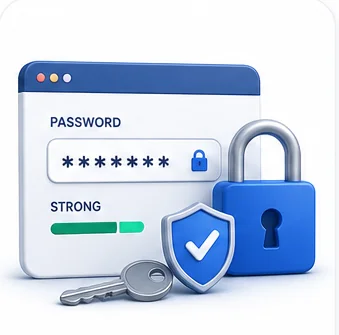
For years, the standard password advice was: one capital letter, one number, one symbol, minimum eight characters. That advice is outdated and, in some real ways, actively counterproductive — it pushes people toward passwords like "Password1!" that satisfy every rule while being trivially easy to guess, and toward complexity that's hard to remember without writing it down somewhere insecure.
What actually makes a password hard to crack
The real enemy of password security isn't a lack of symbols — it's a small search space. An attacker trying to guess or brute-force a password is essentially searching through every possible combination until one works. Length matters enormously more than complexity for this: every additional character multiplies the number of possible combinations, while adding one more symbol requirement barely moves the needle by comparison.
The passphrase approach
A passphrase strings together several random, unrelated words — something like "correct horse battery staple" (a genuinely famous example for good reason). The randomness and unrelatedness of the words matters: a phrase that makes grammatical sense, or that relates to something guessable about you (a pet's name, a birthday), is weaker than truly random word selection, even if it looks similarly long.
- Aim for at least four to five random, unrelated words for a genuinely strong passphrase.
- Avoid common phrases, quotes, or song lyrics — these are exactly the kind of predictable pattern password-cracking tools check for first.
- Adding a number or symbol somewhere within the passphrase (not just at the very end, which is the most predictable place) adds a small amount of extra strength without meaningfully hurting memorability.
Why password reuse is the real danger, more than weak passwords
Even a genuinely strong password becomes a liability if it's reused across multiple accounts — because the real-world way most accounts actually get compromised isn't someone brute-forcing your password directly; it's a completely unrelated website getting breached, its password database leaking, and attackers then trying that same email/password combination against every other popular service. A strong, unique password on every account contains that damage to just the one breached site.
A practical system that balances security and memorability
- Use a genuinely unique, long passphrase for your most critical accounts specifically — your primary email (since it's the recovery point for almost everything else) and your password manager if you use one.
- For everything else, use a password manager to generate and store a unique, random password per site — this removes the need to remember dozens of passwords at all, and each one can be maximally random since you'll never need to type it from memory.
- Never reuse a password across more than one account, even ones that feel low-stakes — a breach anywhere in that chain puts every account using the same password at risk.
- Enable two-factor authentication wherever it's offered, especially for email and financial accounts — it protects you even if a password does eventually leak.
Signs a password genuinely needs to be changed
Regularly forcing password changes on a fixed schedule with no actual reason turns out to encourage weaker passwords in practice, since people take shortcuts (like incrementing a number) under that pressure. A more effective trigger is event-based: change a password immediately if you're notified of a breach involving that account, if you've ever reused it somewhere that later got breached, or if you suspect any unauthorized access.
Common Mistakes
Reusing the same password across multiple accounts
A breach at any one site exposes that password everywhere else it was reused. This is the single most common way accounts actually get compromised, regardless of how strong the password itself is.
Choosing a short, complex-looking password over a longer simple one
Length contributes far more to actual crack-resistance than symbol complexity does. A long passphrase of random words is typically both stronger and easier to remember than a short, symbol-heavy password.
Using a passphrase built from personally guessable words
Words related to you specifically (names, birthdays, pets) are weaker than truly random word selection, since an attacker who knows a little about you can narrow the search space significantly.
Generate a Strong Password
Generate, customize and analyse secure passwords with intelligent controls.
Frequently Asked Questions
Related Articles
Productivity Guides
QR Codes for Business: Practical Uses Beyond Menus
QR codes became a restaurant-menu cliche, but the underlying technology is genuinely useful well beyond that — here are the practical business uses that actually save time.
Productivity Guides
How to Organize and Name Your Documents Like a Pro
Most document chaos comes from inconsistent naming and folder structure, not too many files. A few simple conventions fix almost all of it.
Business Documents
Are Digital Signatures Legally Binding? A Practical Guide
In most parts of the world, yes — with real conditions attached. Here is what actually makes a digital signature enforceable, and where paper still wins.